Joe Turner and Dan Greene venture West to the land of the Far East and the best snow on Earth! As our January plans got botched we ended moving things back to March. As March approached things started to get a little warm and dry in the Land of the Rising Sun we were a little skeptical as to what our conditions would be. Dan arrived a day before me and it was a bullet proof rain crusted snowpack but the day I arrived it started to snow and didn't stop. Here is what our week looked like.

Official Blog for Joe Turner "Turns" the Rocky Mountain Horseman; International Horseman & Adventure Athlete. Adventure awaits one journey at a time!
Sunday, September 25, 2016


Thursday, August 18, 2016
The Ethics of Horsemanship
The Ethics of Horsemanship
In 1994 the German National Equestrian Federation published a booklet, “Ethical Principles for the True Horseman”. The following are the nine ethical principles they included:
1. Anyone involved with a horse takes over responsibility for this living creature entrusted to him.
2. The horse must be kept in a way that is in keeping with its natural living requirements.
3. Highest priority must be accorded to the physical as well as psychological health of the horse, irrespective of the purpose for which it is used.
4. Man must respect every horse alike, regardless of its breed, age and sex and its use for breeding, for recreation or in sporting competition.
5. Knowledge of the history of the horse, its needs, and how to handle it are part of our historic-cultural heritage. This information must be cherished and safeguarded in order to be passed on to the next generations.
6. Contact and dealings with horses are character-building experiences and of valuable significance to the development of the human being – in particular, the young person. This aspect must always be respected and promoted.
7. The human who participates in equestrian sport with his horse must subject himself, as well as his horse to training. The goal of any training is to bring about the best possible harmony between rider and horse.
8. The use of the horse in competition as well as in general riding, driving and vaulting must be reared toward the horse`s ability, temperament and willingness to perform. Manipulating a horse`s capacity to work by means of medication or other “horse-unfriendly” influences should be rejected by all and people engaged in such practices should be prosecuted.
9. The responsibility a human has for the horse entrusted to him includes the end of the horse`s live. The human must always assume this responsibility and implement any decisions in the best interest of the horse.
Understanding the nature of the horse and practicing natural horsemanship encompasses these principles. It is our responsibility as our horse`s partner to live by these principles.
Thursday, May 26, 2016
Summer Horsemanship Series
Hello Everyone. Here is the info for the Summer Horsemanship Series happening in June
If you have any questions please feel free to call 406-285-1754 or email info@turnerhorsemanship.com


Tuesday, May 24, 2016
GRR Poker Ride on "50 Shades of Grey" - May 2016
2016 Gallatin River Ranch Poker Ride, riding "50 Shades of Grey" a young Tennessee Walking Horse mare that I have had the pleasure of starting this Spring. Here she is with about 30 days on her and her first major trail ride off the ranch. It was very wet and very rainy but we had a great ride none the less.
First time in the 2 Horse Trailer was the day before.
Smooth as butter coming out just asking for her to back by lifting her tail.
A little break looking into one of the many valleys along this 10k ride.
I ended up with a pair of 6's for my hand so I didn't even come close to winning but the real winner was "50 Shades of Grey"!
She had an awesome trail ride and except for about the first mile "50" was willing to give it her 100% in effort. She did great with other horses coming and going, being able to work off leg pressure and also rein pressure. Working and Free Walk & Jog are really shaping up and her canter is very nice as her gait as just so dreamy. Things we worked on quite a bit was not running down hills (which is very common in young horses) and maintaining gait when increasing to faster speeds of gait (instead of breaking into a trot or pace).
I am very much looking forward to redemption in the next Poker Rider, come on 4 Aces!
Until then Be Safe & Have Fun!
Joe Turner
Sunday, May 22, 2016
Halter Correct
This article is an explanation on how to fit and tie a rope
halter properly to your horse. I want to explain the “how and why” we tie rope
halters properly on our horses, we do this to provide proper function and to
create the absence of pain and the absence of dangerous situations. Along with
this article are some images that are included to show the proper placement of
a rope halter and the proper way to tie your halter, also included is an image
of a mis-tied halter also showing improper placement. In addition are included some
images of the horse’s skull and facial nerves to help provide visual information
on anatomy of horse’s head.
The rope halters that I like to use are made from a medium
weight, semi-firm in stiffness material so they do not move around on the
horse’s face and provide immediate contact in all the correct places on the
head to be able to control horse with minimal but effective pressure to the
facial nerves. The halter rope should not be too thick or to thin (around
7mm-8mm), thin halters can provide pain, rope burn and too much pressure on the
facial nerves and loose halters are sloppy and don’t stay in place on the head
which provides inconsistent techniques where as too thick of rope will not
provide adequate pressure and have the same effectiveness as a web halter.
The two most common mistakes that I see are 1.) the proper
way of tying the halter to the horse and 2.) the correct placement of the rope halter
on horse’s head. Below, in image #1 you can see the proper tying and position
of the halter on the horse’s head, image #2 is an example of an incorrect
fitting halter, image #3 is of the facial nerves of the horse and image #4 is
of a horse’s skull showing the bones and structure of the head.


Good Fit – Nose band is high on the bridge Bad Fit- Nose band sits low on the
of the nose, Throatlatch is behind the jaw, face, no contact with facial nerves
and head piece is just behind the Poll. and Throatlatch is across cheeks
and
jaw, head piece is correctly placed.

This image shows
where the facial nerves lie under the skin and show
the proper lines of
pressure and knot placement of halter.

This photo of the
horse’s skull shows how thin and fragile the Nasal Bone
is and how sharp the
edge of the jaw bone (Mandible) is. From this picture
you can see how the
edge of this sharp bone can cause pain when pulling
on a halter that
crosses the cheek and jaw-line and how a low-fitting halter can possibly injure
the nose of the horse.
These next set of photos show the progressive steps to
properly tie the halter on the horse.
1.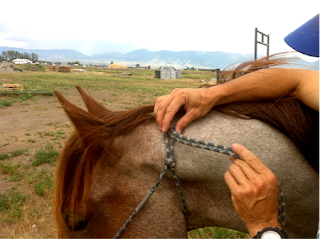

Pull Loose end of the
Halter through the eyelet like in picture bringing the remaining end towards
the rear of the horse.
2.

Pass end behind and
under eyelet and thus creating a loop with the slack. It is important to note
that this loop is made under the top bridge of the eyelet and not above which
would then not allow the knot to come untied once weighted.
3.

Pass end of rope
through the newly created loop and pull tight.
4.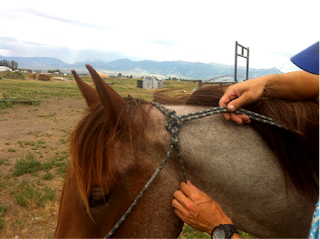

Make sure that the
halter rope is not twisted and the halter is snug and correctly fitting with noseband
and throatlatch.
5.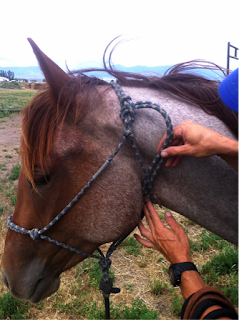

Noseband should sit
just above the halfway point between the eyes and end of the nose. Throatlatch
knot should be placed at the junction of the neck and head while the sides of
the Throatlatch should sit snugly behind the jaw line. Tuck loose end into the
halter behind the jaw and Happy Trails!
6.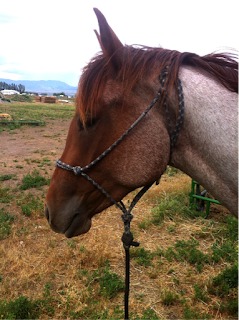

A correctly tied and
fitting halter!
Tuesday, May 17, 2016
Spring Rodeo Avoidance Tips
Hello Everyone,
Wow it has been a long time since I have been on this Blog, I almost forgot about it ;-)
Well I am going to try to be a little more diligent with using it so I can kind of stay in touch and keep you all updated on my adventures around the globe with horses and skis and family and such.
Needless to say a ton has happened since my last reported sighting but the thing I am most happy about is that we are expecting the stork to deliver us a little baby boy near the beginning of July. Woohoo a new little skiing and horse riding pardner! I can't wait, this kid has been kicking up a storm while slouching away his days in the womb. He wants out, his brother wants him out, I want him out and Mom well she's getting there and sister will make up her mind when he gets here. As expected we are all super excited! Well now I am just rambling so let me get to the point of why I am writing this piece.
It is Spring and we all want to go get our trusty steeds off the winter pastures and saddle up and ride off into the sunset just like we left off at the end of last summer. Well you just might want to slow your roll and think about a little Spring Cleaning first, not only of the Tack Room but of your horse's mind too. Chances are that while over the winter days of looking for every blade of grass to the plush pastures in bloom right now that riding kind of took a back seat and this human/equine partnership is not quite as cool as the other four legged fly swatters all around them.
Before my first ride of the Spring on a horse, that I may have not touched in a few months, I like to do a little fence work in addition to the rest of my Pre-Ride Safety Check. I also like to do this fence work to colts I am starting and when reeducating horses that may have had a difficult past as well as any other time I feel it may benefit the horse and keep me safe.
Here are some pictures and descriptions of some of the fence work I like to do. This is much easier to do if you have already taught your horse how to step up to the fence and position themselves for you to mount.
Things to note: I have the lead end of my Mecate Rein draped over my left arm so when the horse decides to leave I still have contact. I am never pulling on the reins or making my horse stand still because I want my horse to have every option possible for their comfort. The horse is completely loose and always has the option of leaving without punishment or discomfort. Also remember that timing is everything and the biggest reward is release of pressure or when the feeling of discomfort ceases.

Image #1: I really like to have a nice fence to stand on, this way the horse can see me in the same position as if I was sitting in the saddle and over them as well if the horse decides it needs to move his or her feet quickly to feel safe or more comfortable then they can do so and I am not in risk of getting hurt or falling off. Standing safely on the fence I can reach over and create some commotion on both sides of my horse. I like using my rope and saddle strings to lightly bounce all over my horse as well as pick up the stirrups on both sides and let them flop around. I also slap the saddle a bit to create a scary noise. If the horse gets scared and squirts off then just re-set your horse along the fence and continue the progress all the while making sure to give lots of praise and reward when your horse gives effort to standing calmly.

Image #2: Create a loop with your Lariat and slide it over the horse's haunches letting the rope rub them all over their hind legs and rear end. It might be a little scary at first but boy you will sure be glad when that brush or the hidden wire in the grass gets ya!


Image #3: It is a good idea to toss a few loops over them as well so they can see something moving over them quickly. You never know what can happen on the trail especially when those low hanging branches decide the path was the best realty.
Image #4: Bringing the rope back into the coil is also great for them to see something coming towards them and to look to you for confidence. Nothing like a scary snake on your ride just to brighten the day :-)

Image #5: Using the fence provides a great opportunity to throw a leg over while still standing on the fence. If horse squirts off then you are still safely standing on the fence. Which is a nice feeling!
Well I hope this gives you all some ideas of how to help create an enjoyable first ride of the spring instead of the neighborhood's first Rodeo. Remember its all about Safety, Safety, Safety and then you can have your fun. Perform your Pre-Ride Safety Check and go ride off into the Wild Wild West on your trusty steed!!
Look for the RMH Summer Horsemanship Series info and dates to be released soon!
Until next time,
Be Safe & Have Fun,
Joe Turner
PC: Klaudia Turner
Wow it has been a long time since I have been on this Blog, I almost forgot about it ;-)
Well I am going to try to be a little more diligent with using it so I can kind of stay in touch and keep you all updated on my adventures around the globe with horses and skis and family and such.
Needless to say a ton has happened since my last reported sighting but the thing I am most happy about is that we are expecting the stork to deliver us a little baby boy near the beginning of July. Woohoo a new little skiing and horse riding pardner! I can't wait, this kid has been kicking up a storm while slouching away his days in the womb. He wants out, his brother wants him out, I want him out and Mom well she's getting there and sister will make up her mind when he gets here. As expected we are all super excited! Well now I am just rambling so let me get to the point of why I am writing this piece.
It is Spring and we all want to go get our trusty steeds off the winter pastures and saddle up and ride off into the sunset just like we left off at the end of last summer. Well you just might want to slow your roll and think about a little Spring Cleaning first, not only of the Tack Room but of your horse's mind too. Chances are that while over the winter days of looking for every blade of grass to the plush pastures in bloom right now that riding kind of took a back seat and this human/equine partnership is not quite as cool as the other four legged fly swatters all around them.
Before my first ride of the Spring on a horse, that I may have not touched in a few months, I like to do a little fence work in addition to the rest of my Pre-Ride Safety Check. I also like to do this fence work to colts I am starting and when reeducating horses that may have had a difficult past as well as any other time I feel it may benefit the horse and keep me safe.
Here are some pictures and descriptions of some of the fence work I like to do. This is much easier to do if you have already taught your horse how to step up to the fence and position themselves for you to mount.
Things to note: I have the lead end of my Mecate Rein draped over my left arm so when the horse decides to leave I still have contact. I am never pulling on the reins or making my horse stand still because I want my horse to have every option possible for their comfort. The horse is completely loose and always has the option of leaving without punishment or discomfort. Also remember that timing is everything and the biggest reward is release of pressure or when the feeling of discomfort ceases.

Image #1: I really like to have a nice fence to stand on, this way the horse can see me in the same position as if I was sitting in the saddle and over them as well if the horse decides it needs to move his or her feet quickly to feel safe or more comfortable then they can do so and I am not in risk of getting hurt or falling off. Standing safely on the fence I can reach over and create some commotion on both sides of my horse. I like using my rope and saddle strings to lightly bounce all over my horse as well as pick up the stirrups on both sides and let them flop around. I also slap the saddle a bit to create a scary noise. If the horse gets scared and squirts off then just re-set your horse along the fence and continue the progress all the while making sure to give lots of praise and reward when your horse gives effort to standing calmly.

Image #2: Create a loop with your Lariat and slide it over the horse's haunches letting the rope rub them all over their hind legs and rear end. It might be a little scary at first but boy you will sure be glad when that brush or the hidden wire in the grass gets ya!


Image #3: It is a good idea to toss a few loops over them as well so they can see something moving over them quickly. You never know what can happen on the trail especially when those low hanging branches decide the path was the best realty.
Image #4: Bringing the rope back into the coil is also great for them to see something coming towards them and to look to you for confidence. Nothing like a scary snake on your ride just to brighten the day :-)

Image #5: Using the fence provides a great opportunity to throw a leg over while still standing on the fence. If horse squirts off then you are still safely standing on the fence. Which is a nice feeling!
Well I hope this gives you all some ideas of how to help create an enjoyable first ride of the spring instead of the neighborhood's first Rodeo. Remember its all about Safety, Safety, Safety and then you can have your fun. Perform your Pre-Ride Safety Check and go ride off into the Wild Wild West on your trusty steed!!
Look for the RMH Summer Horsemanship Series info and dates to be released soon!
Until next time,
Be Safe & Have Fun,
Joe Turner
PC: Klaudia Turner
Wednesday, February 11, 2015
Respect Issues in the Box or Stall?
Respect
issues in the Box or Stall?
For all those who have been to my clinics this is just a
refresher but for all the others who ask me about working with your horse in
his/her stall or ask is there a time frame in which I have to show my horse “I
am the boss” when one enters the horse’s stall? Here I will answer and clarify
my response.
First off let me say that we are never trying to show the horse we are boss, we want to
communicate to the horse that we are Safe & Confident Leaders and we are working on a partnership level not a
boss/employee level.

I don’t believe in working with your horse in their stall or
box for respect! There is no magical number of minutes that will get your horse
to respect you. You cannot approach your horse with a “must do” attitude because
you will have create resistance and defiance from the horse. This dominating
behavior is the same as an employer or a schoolteacher coming into our own
homes and bedrooms and telling us to work harder or do our homework or simply
just direct us around when we are resting and enjoying our personal safety zone
of relaxation and comfort. The stall is the horse’s sanctuary of peace, I sure
don’t want to violate that. Imagine a drill sergeant running into the soldier’s
barracks at 4:00am and making everyone jump up and make their beds and do 50
push-ups “on the double”, I know I didn’t sign up for the Army and pretty sure
my horse didn’t either. If we humans don’t like it when our personal spaces are
violated then why should the horse like being violated as well? The most I will
do with my horse when I enter their boxes or stalls is to make sure I am not
put into a dangerous situation whether I am cleaning, feeding, doctoring, watering
and/or haltering them up for a ride. If you are having issues in the box or
stall then you need to remove the horse and yourself from the box and move into
a training facility like a round pen. All respect issues and training
procedures should be done outside and away from the stall, this is very
important, removal from the “relaxing environment” will free up the thoughts in
the horses brain and take away the need to defend their personal space. The
activities of the outside world will create an environment engages the brain
and provides the ability for the thought process and focus can be free and then
redirected to performing the task at hand.

When done properly and the horses are worked with respect
and kindness then you will notice that you will remove any uncomfortable or
unsafe situations or problems when in their bedrooms aka boxes/stalls. Remember
to treat the horse as if it was you who is under saddle, on the end of the
Lead-Line or in the box stall. When you create this type of relationship then
you have Leadership, Safety and a horse that waits on you willingly whether in
the box or in the pasture!
Be Safe & Have Fun,
Joe Turner
Rocky Mountain Horseman
Wednesday, February 5, 2014
SIA 2014 and Icelantic's Winter on the Rocks!
Well, SIA Denver never fails to be one of the best (not including the On-Snow portion) non-skiing events of the year! Every year we get to look forward to seeing all the new gear, garb and schwag that will be released and sold for the upcoming 2014-2015 Winter Ski Season. There are all kinds of nifty new gadgets and doodads out on the market so getting to play and experiment before they come out, for the general public, is always fun. Some of the cool new thingies that I got to check out included some cool new gloves that control phones, iPads and video cameras including GoPros all at once! There will be released some new Avy Packs and I am diggin the new threads coming out for this next year especially from Picture Clothing! The French Gastrique theme is killer and the style is some of the best out on the market, top that off with technicality that functionality that are unbeatable and bomber, Winner!!! Got to check out some of the new mind blowing features of the new Zeal Optics Ion Goggle with built in Video Camera and of course my fav, all new for 2014-2015 is The Ranger by Icelantic Skis. Can't wait to rally this bad boy in the mountain office soon!! Check them out soon at www.icelanticskis.com!
I get so wrapped up in all the new goodies that I sometime forget that SIA also is synonymous with Icelantic's Winter on the Rocks Concerts at Red Rocks Amphitheater in Morrison, CO! This year's line-up started off with the killer Ghostland Observatory, are these guys awesome! Never heard of them so checked them out online before seeing them live and they absolutely rocked it live! Great energy, great songs and a phenomenal light show that was reflecting off the falling snow, mind blowing to say the least! Although G.O. was good we were all there to see Jurassic 5 and in good ol J5 fashion we were treated to the show that we have all been dreaming of since last year's WOTR with Macklemore. J5 has continued to throw down smooth, fast complex lyrics with good energy and vibes for the past 15+ years and are fav amongst those who like true Hip Hop! It was definitely a Do Not Miss show!
Heres a few pics from the SIA and WOTR shows. I am so looking forward to next year already. Stay tuned throughout the summer to find out who is going to be on next year's WOTR lineup, it is guaranteed to be a winner!
Hope to see you there next year!

Icelantic Skis Booth at Sia 2014

Icelantic Skis' theme for 2014-2015 Lineup "Return to Nature" Sculptures by Travis Parr

The all new Ranger from Icelantic Skis

Icelantic Skis' Nomad RKR, my everyday go to tool!

The Gypsy by Icelantic, my best friend in the BC!

Patrick "Kuru" Gannon and myself gettin' some Icey love!
Hope to see you there next year!
SIA 2014
Icelantic Skis Booth at Sia 2014
Icelantic Skis' theme for 2014-2015 Lineup "Return to Nature" Sculptures by Travis Parr
The all new Ranger from Icelantic Skis
Icelantic Skis' Nomad RKR, my everyday go to tool!
The Gypsy by Icelantic, my best friend in the BC!
Patrick "Kuru" Gannon and myself gettin' some Icey love!

The killer light show during Ghostland Observatory, Icelantic's Winter on the Rocks!

Klaudia Kundzik and myself enjoying the snow and music at WOTR 2014!

Love Red Rocks Amphitheater, coolest venue ever! Icelantic's Winter on the Rocks 2014
Monday, January 6, 2014
The Power of Words (Power of Positive Thinking)
How much do horses understand? Can he understand when I tell him something? If I say walk, trot or canter does my horse know what I am asking? Well, the answer is yes and no. Horses just like humans do not start off with an understanding of the English language or any other spoken language for that matter but they do have an ability to communicate and remember. The same goes for humans but we have also learned that there are certain emotions that are connected to specific words. An example, would be, try saying “I Love You” to someone you don’t know or better yet next time your horse does something incorrect (like trying to go back to the barn or buddy over and over again) try saying “Good boy/girl”. Doesn’t work very well does it? So let’s use this knowledge and power for our own benefit and help solidify our partnerships.
Talking to your horse is great for you and your horse, if you can associate certain words to specific actions through training then you can train your horse to understand commands but that’s about the extent of it. Where the true communication comes from is your body language and if we can use certain words to control or direct our own emotions and thus our body language then we can truly direct our horses using the path of leadership. Emotions come from the inner core of our being and will always show no matter the situation especially in the more stressful.
 The question is, are we aware of what we are really “saying”? Just by speaking a certain word we have power over our emotions. Speaking a word invokes thoughts of that word and its meaning and therefore becomes the focus of your emotions. Next time that you get upset and are having a hard time trying to refocus on calmness take a few deep breaths and try saying something nice to someone or yourself, better yet next time you are on your horse and one or both of you start to get upset, anxious or uncertain bring both of your energies back down to a thinking state with a “Good boy/girl” and a quick neck rub!
Notice that when you actually say the positive words the tense energy in your body will dissipate and start to relax and then watch the change in your horse while their energy subdues and matches your energy level. The physical response of your body just by speaking is that it is naturally set up to relax, this is because when you inhale your diaphragm tightens and lifts up to expand the lungs to hold lots air while when speaking you exhale and your diaphragm, lungs and muscles of the core of the body relax! All this from the effects of thinking positive words and then saying them with our mouths and then with our bodies. It’s amazing.
Tips for True Leadership! Stay tuned for more…
Be Safe and Have Fun,
Joe Turner Rocky Mountain Horseman
Talking to your horse is great for you and your horse, if you can associate certain words to specific actions through training then you can train your horse to understand commands but that’s about the extent of it. Where the true communication comes from is your body language and if we can use certain words to control or direct our own emotions and thus our body language then we can truly direct our horses using the path of leadership. Emotions come from the inner core of our being and will always show no matter the situation especially in the more stressful.

Notice that when you actually say the positive words the tense energy in your body will dissipate and start to relax and then watch the change in your horse while their energy subdues and matches your energy level. The physical response of your body just by speaking is that it is naturally set up to relax, this is because when you inhale your diaphragm tightens and lifts up to expand the lungs to hold lots air while when speaking you exhale and your diaphragm, lungs and muscles of the core of the body relax! All this from the effects of thinking positive words and then saying them with our mouths and then with our bodies. It’s amazing.
Tips for True Leadership! Stay tuned for more…
Be Safe and Have Fun,
Joe Turner Rocky Mountain Horseman
Monday, December 9, 2013
The Dominance Hierarchy by Dr. Robert Miller
The Dominance Hierarchy is a scientific term referring to the social interaction within a herd and how leadership is determined.
The word “dominance” infers cruelty. They think that it is cruel to “dominate” a horse, and prefer to think of a “partnership”. Yes, we do want a partnership with the horse. But one of us has to be in charge. One of us must be dominant. This is an animal many times larger than we are, and extremely fast moving and physically strong and if we are not dominant in the horse’s mind, we are in danger.
Dominance means leadership. Now, granted that there are cruel leaders. But there are also kind leaders, and that’s the role we must assume with the horse.
Yes, Hitler, Saddam Hussein, President Assad of Syria, etc. were dominant, and they were also cruel leaders (Tyrants and Dictators). But other leaders, powerfully dominant, were also kind (Love and Empathy). Think of Mahatma Gandhi, Martin Luther King, George Washington, and Thomas Jefferson. Was there a more dominant individual in all human history than Jesus Christ?
So, now that we have made it clear that a leader can be absolutely dominant, but also supremely kind, let’s discuss the way we humans can dominate the horse.
Creatures that live in groups in a natural environment such as wild horses, elephants, wolves, chimpanzees, chickens, dolphins, and human beings, establish their Dominance Hierarchy in very different ways.
Horses do so by controlling the movement of their peers. They control the feet. Why? Probably because the primary defense of the horse is flight. Unlike the other species just named as examples in which flight is an alternate form of defense, for the wild horse flight is the first choice. Horses lack horns or tusks, fangs, or other weapons. For the horse, in its natural grasslands habitat, the best way to survive hungry predators is immediate flight.
Thus, the leader of a mustang band is usually an older mare because she has the experience as to when to run, how far to run, and where to run. She isn’t the strongest or largest or most athletic member of the group, but she constantly reminds them of her authority by using movements and expressions, which cause them to move. They respond by moving and with expressions of submissiveness to her such as lowering their heads and licking and chewing. This simulates grazing or drinking, and that’s when a wild equine is most susceptible to be charged by a predator. That’s when a horse is most vulnerable. Many species signal submission by assuming a position of greatest vulnerability for that specific species.
With these concepts in mind, we can now understand why, as long as the horse has been domesticated, we humans have used control of movement to establish our dominance over it. So we longe them, we propel them around a round pen, we hobble them, we lay them down, we immobilize them, we halter break them, move them in all directions, hitch them in harness next to a well broke horse, pony them from an experienced lead horse and tie them for prolonged periods of time. Movement can be controlled in two ways: By encouraging and directing it, or by preventing it. If we do this with horses, we obtain dominance.
Unfortunately, throughout history, these methods have been too often combined with excessive and usually unnecessary coercion. This includes whipping, spurring, and other methods of inflicting pain, aggressive and threatening language, posture and attitude.
Why? Why do we do this when rare horsemen throughout history have discovered and used and taught gentler, less intimidating, and more humane methods of obtaining dominance and responsiveness from the horse. They won leadership by controlling movement, but avoiding causing unnecessary fear.
Why have their methods not been used by most horseman until the present revolution in horsemanship began in the late 20th century?
The answer is because we are genetically programmed to use force to control our animals. After all, biologically speaking we are a predatory species. For hundreds of thousands of years we (mainly the males) hunted to subsist. Being a tool using species, we were the most effective predator in the world. So, it’s natural for us to use tools to be aggressive and forceful with our domestic animals.
But, we are also a reasoning species. That means we can be taught not to act like a predator when working with horses if we are willing to learn, and if we are attentive students. We can control movement in the horse without causing unnecessary fear. Our goal should always be 100% respect (dominance) but zero fear. The horse, a remarkable adaptable, forgiving, and compliant creature will serve us either way, but which way is more civilized and which celebrates our intelligence and our reasoning power? Which method expresses our primitive qualities and which expresses the most admirable of all human attributes; kindness and intelligence?
Robert M. Miller, DVM

Subscribe to:
Posts (Atom)